Duolingo Got You to A2. Here's Why It Won't Get You Much Further
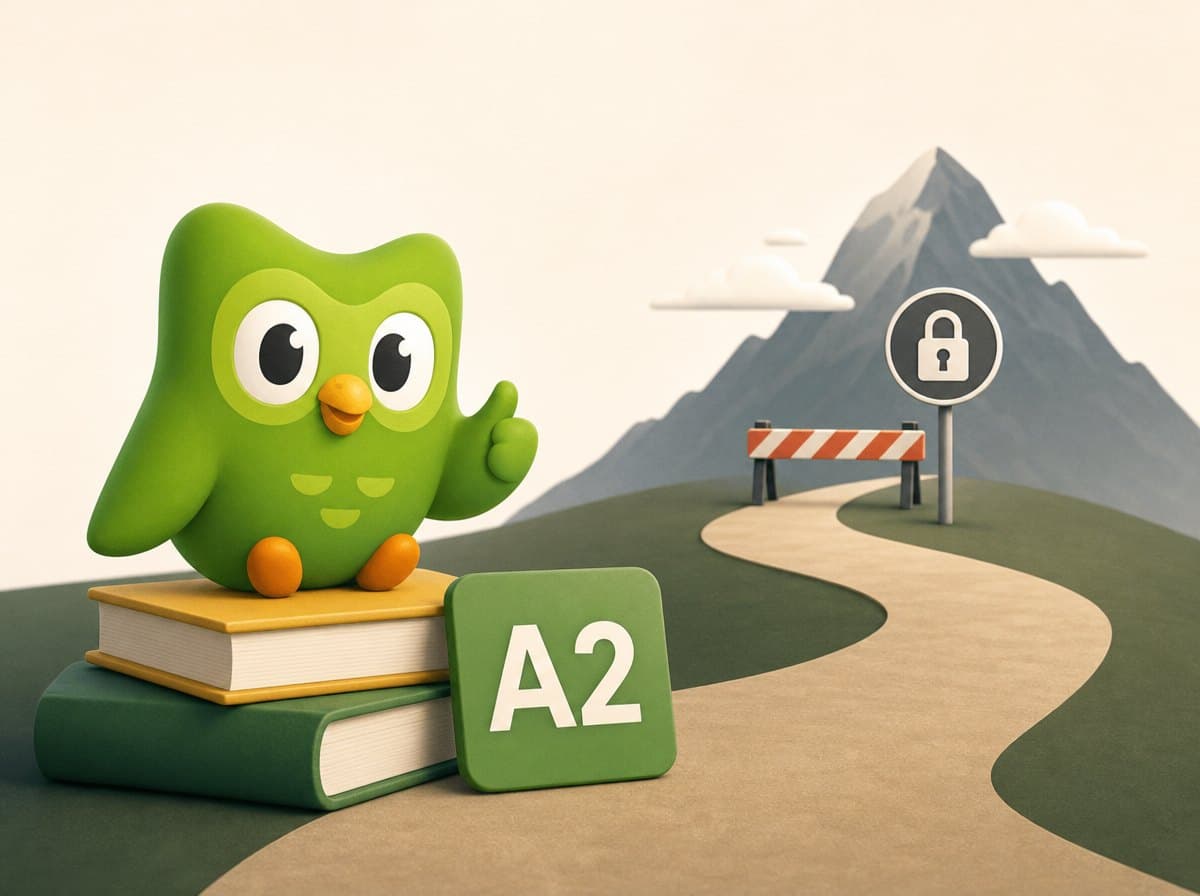
Duolingo gets an unfair amount of both praise and blame in German learning conversations, so let's use what the actual studies say instead of the usual back and forth on forums.
A 2025 study found Duolingo learners scored higher on proficiency tests than classroom learners after one semester of language study. A separate 2026 study on French found Duolingo learners had comparable communication skills to classroom students after a semester. Take a second to notice what both of those have in common: one semester, meaning early stage learning. That's the range Duolingo is actually built for and tested in.
Where the app genuinely earns its reputation
For the first several months, Duolingo does something classroom courses often struggle with: it gets you repeating vocabulary and basic structures constantly, in short sessions, without the friction of scheduling a class or feeling embarrassed in front of other students. The current German path roughly covers A1 through B1 on the CEFR scale, which is real, useful ground. If your German is currently at zero, Duolingo will move you faster than doing nothing, and probably faster than a slow paced group class too.
That's a genuine strength, not a consolation prize. Early vocabulary acquisition and pattern recognition are exactly what gamified repetition is good at.
Where it quietly stops helping
The gap shows up around the same point almost every honest review mentions: real conversation. The app's own research and independent reviewers agree on this. Speaking and spontaneous conversational practice are limited on the platform, which matters a lot once you're past basic phrases, because actual fluency depends on what linguists call the interaction hypothesis. You improve fastest when you're in a live exchange, make a mistake, get corrected or misunderstood, and have to adjust in real time. An app can simulate parts of this. It cannot replicate the pressure and unpredictability of a real person expecting an answer from you in three seconds.
This is exactly why so many learners describe hitting a wall around B1. They can tap through exercises correctly, recognize grammar patterns, translate signs and menus without trouble, and then freeze the first time someone asks them an unscripted question in German.
The honest way to use it
None of this means quit Duolingo. It means stop expecting it to do a job it was never built for past a certain point.
Treat it as what the research supports: a strong on ramp for vocabulary and pattern exposure in the early months, running alongside something that forces actual output, speaking, writing full sentences, responding to unpredictable prompts rather than selecting from four options. The learners who get stuck are usually the ones who stayed in tap and match mode long after they needed to be constructing their own sentences from scratch.
This is the exact gap Germanly is built around, structured practice that pushes you to produce language, not just recognize it, so the transition out of app only learning doesn't leave you stranded at the same B1 wall everyone else hits.
A note for anyone prepping for an actual German exam
If you're building toward a Goethe or TestDaF certificate for university admission or a visa file, this gap matters more than it might seem from a casual learning perspective. Those exams score a speaking section with a real examiner, and a writing section that grades your ability to construct an argument, not select the right multiple choice answer. Nobody at a testing center hands you four options and asks you to tap the correct one.
Candidates who arrive having only ever practiced recognition based exercises consistently describe the speaking module as the roughest part of the exam, not because their vocabulary was thin, but because they'd never actually rehearsed producing full, unscripted answers under a clock. That's a rehearsal gap, and it's fixable with weeks of dedicated practice, not something that requires starting over.
What to actually do with this
If you're early, keep using Duolingo daily. It's doing its job. If you're past six months in and progress has slowed, that's not a motivation problem. It's a method problem. The tool that got you here isn't the tool that gets you to the next level, and no amount of extra streak days changes that math.
Swap some of your app time for anything that requires you to generate a full sentence under time pressure: a short daily writing exercise, a structured speaking session, even narrating your day out loud in German for two minutes. It'll feel harder than another lesson tree. That difficulty is the actual signal you're finally training the skill the app couldn't reach.
None of this makes Duolingo a bad product. It makes it a beginner tool being asked to do an intermediate job it was never designed for. Recognizing that distinction early saves months of frustration for anyone who assumed a longer streak would eventually translate into a real conversation on its own.
Start your own German story
A1 to B2 — vocabulary, grammar, real audio and AI feedback. First three lessons free.