Duolingo Won't Teach You German. Here's the Actual Pattern That Does
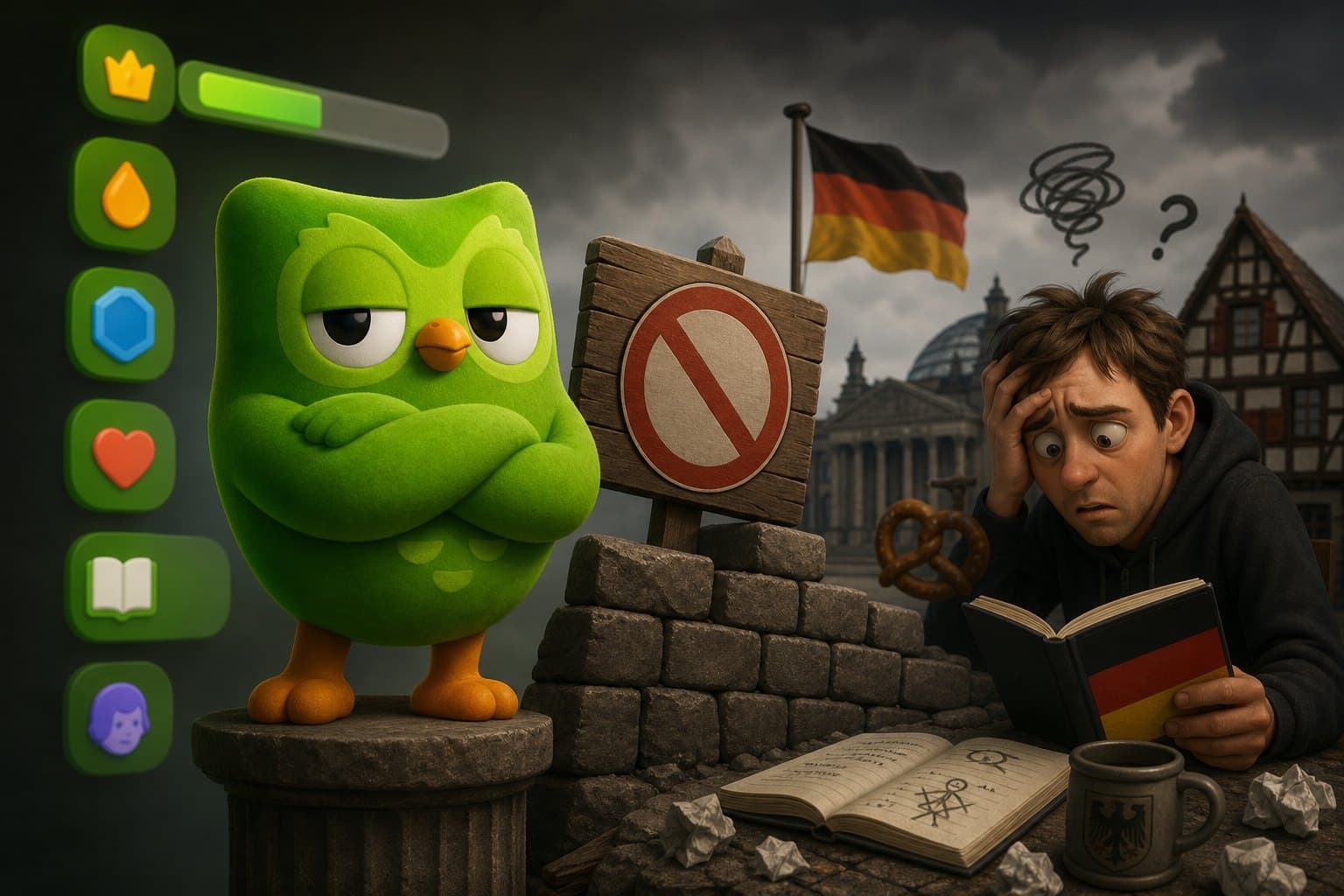
Duolingo isn't broken. That's actually the confusing part. The lessons are well made, the streaks work as motivation, and the app genuinely teaches vocabulary. The problem is that people mistake "an app that works" for "the whole system that produces fluency," when acquiring a language actually runs on four separate mechanisms, and a single tool covering one of them well was never going to cover all four.
Let's break down what those four mechanisms actually are, because once you see them separately, it becomes obvious why so many learners plateau at almost the exact same point.
One: input just above your current level
Linguist Stephen Krashen's core finding, still one of the most cited ideas in the field, is that people acquire language by understanding input slightly beyond what they already know, often written as i+1. Not material that's too easy, which teaches nothing new, and not material that's too hard, which just creates noise. The sweet spot is content you can mostly follow with real effort.
This is the piece apps do reasonably well. Duolingo's leveling system genuinely tries to sit at that edge. Where it runs into trouble is that its notion of "input" stays narrow: short, isolated sentences designed to test a single grammar point, rather than the kind of connected, situational input that mirrors how you'll actually encounter German in a lecture hall, a job interview, or a landlord conversation.
Two: pushed output, not just recognition
Krashen's theory says input alone should be enough. Another linguist, Merrill Swain, studied learners who got tons of quality input and still couldn't produce fluent language, and found the missing piece: being pushed to produce output forces you to notice gaps in your own knowledge that input alone never surfaces. You don't realize you don't know the word for "landlord" until you're mid sentence trying to complain about your heating.
This is exactly where tap and match style apps fall apart. Selecting the correct translation from four options tests recognition, not production. You can pass hundreds of exercises without ever constructing an original sentence under pressure, which is precisely the skill that speaking exams, job interviews, and actual conversations demand.
Three: spaced review, not one time repetition
Memory research going back over a century, the forgetting curve work originally done by Hermann Ebbinghaus, shows that new information decays fast unless it's reviewed at increasing intervals: a day later, then a few days, then a week, then a month. Cramming a word ten times in one sitting feels productive and barely helps. Seeing it again right as you're about to forget it is what actually moves it into long term memory.
Most casual practice, including a lot of app usage, drifts toward repetition inside a single session rather than deliberately timed review across days and weeks. That's a scheduling problem as much as a content problem, and it's one of the easiest pieces to get right once you know it needs to exist as its own system, not an afterthought.
Four: low pressure, but actually corrected
Krashen also described something called the affective filter: anxiety, embarrassment, and fear of mistakes raise a kind of mental wall that blocks acquisition even when the input and opportunity are there. This is why so many learners understand German fine alone at home and freeze completely in front of a native speaker. The fear itself is part of what's blocking them.
The fix isn't removing correction, it's removing the social stakes while keeping the feedback. Learners need a space where getting a case wrong or fumbling a verb ending doesn't carry the same weight as doing it in front of a visa officer or a new colleague, but where they're still told clearly what was wrong and why, rather than just moving on to the next card regardless of the answer.
Where Germanly comes in
Put those four together and you get a fairly specific spec: contextual input pitched just above your level, exercises that force real production instead of selection, a review schedule that resurfaces material right before you'd forget it, and a low pressure environment with actual correction rather than silent scoring.
That's the gap Germanly is built to close, not by replacing every other resource you use, but by being the layer that handles production and structured review specifically, the two pieces most casual app use skips. Practice sets are built around constructing full answers, not tapping the right bubble, timed to come back around before the material fades, and framed around situations that actually matter for someone preparing to study, work, or live in Germany rather than generic phrasebook sentences.
Duolingo, or any input heavy app, can still be part of a real plan. It's a solid tool for the first mechanism. It was just never designed to handle the other three, and pretending it could is why so many learners hit the same wall at almost the same point, no matter how long their streak runs.
Start your own German story
A1 to B2 — vocabulary, grammar, real audio and AI feedback. First three lessons free.