Free German Apps Teach You to Recognise Words. They Don't Teach You to Speak.
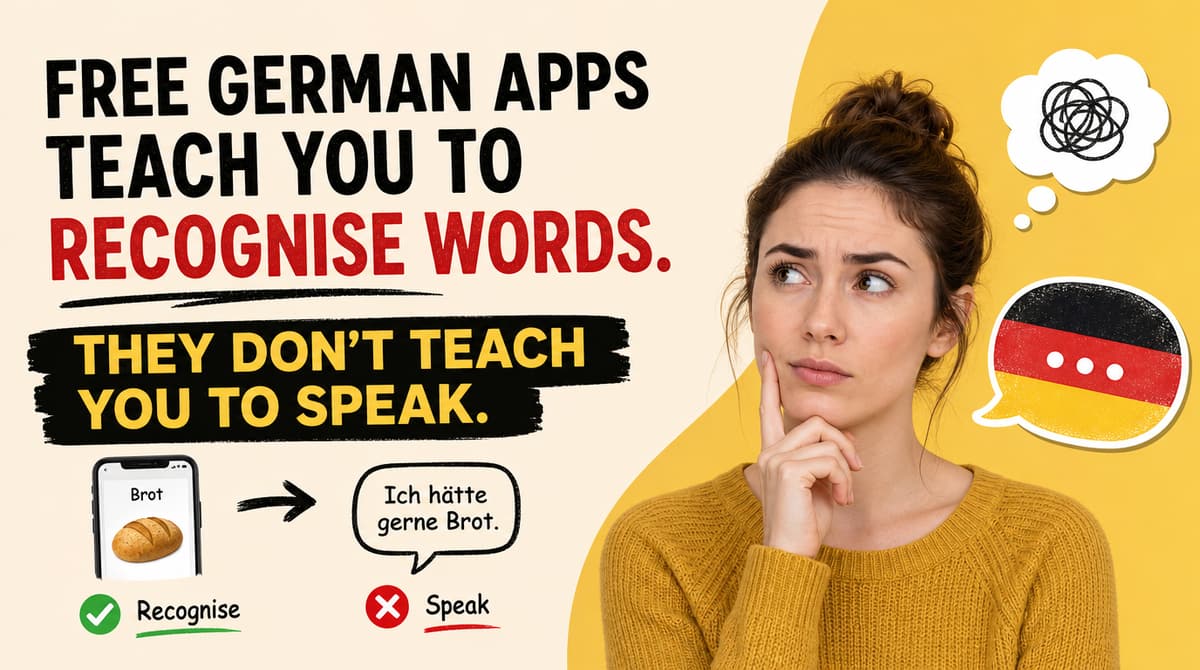
There is a particular kind of German learner I hear from a lot. They have a long streak on a popular app. They can read a menu. They understand maybe half of what a slow speaker says. And when somebody at the bakery asks them a simple question, nothing comes out.
This is not a personal failing. It is the predictable result of practising one skill and expecting a different one to improve.
Recognition and production are not the same muscle
Picking der out of three options is recognition. You are given the answer and asked to confirm it. Saying "ich habe mit meinem Bruder gesprochen" out loud, unprompted, with the right case on meinem and the verb in the right place — that is production, and it is much harder.
Tap-the-right-tile apps are very good at recognition. They are good at it because it is easy to grade automatically, and it feels like progress, and it keeps you coming back. None of that is dishonest. It is simply not the same thing as speaking.
You can see the gap in your own head. Read sprechen and you will recognise it instantly. Now, without looking: what is the du form? What about the past — gesprochen with haben or with sein? Recognition is fast and confident. Production is slow and full of holes.
What makes production hard in German specifically
Three things have to be right at the same time, and all three are decided before you reach the end of the sentence.
The case, which the preposition chose for you. mit, nach, bei, von, zu all take dative, so it is mit meinem Bruder, never mit mein Bruder. You cannot fix this at the end; the ending is in the middle.
The verb's position, which the conjunction chose. In a weil clause the verb goes to the very end, so "weil ich müde bin" — and you have to know that before you start the clause.
The auxiliary, which the verb chose. gehen, fahren, kommen take sein. machen, essen, sehen take haben. Say "ich habe gegangen" and every German speaker hears it.
A multiple-choice exercise lets you solve these one at a time, with the answer visible. A conversation makes you solve all three at once, in real time, while also thinking about what you want to say.
The practice that closes the gap
It is not complicated, and it is not new. Say things out loud. Be corrected. Say the corrected version. Repeat.
What has changed is that you no longer need another person in the room at the exact moment you have twenty minutes free. In Germanly you pick a level and talk to Lena, who speaks at your level, waits while you hunt for a word instead of finishing your sentence for you, and afterwards shows you precisely what was wrong — the actual words you said, the rule behind the mistake, and the sentence as it should have sounded. Then you say it again.
The first time most people do this, two things happen. They find it uncomfortable, and they discover they know less than their streak suggested. Both are the point. The discomfort is the gap closing.
What I would actually do
Keep the vocabulary app if it works for you — recognition is a real part of learning and spaced repetition is genuinely good at it. But add fifteen minutes a week of speaking out loud and being corrected, and do it early, before you feel ready. Waiting until you feel ready is how people end up with a 600-day streak and nothing to say.
Speaking practice in Germanly is free every month, no card, and all of A1 is free too. Have one conversation this week and see what it tells you.
Start your own German story
A1 to B2 — vocabulary, grammar, real audio and AI feedback. First three lessons free.