Guessing Wrong Is Part of Learning German. A New Study Just Proved It
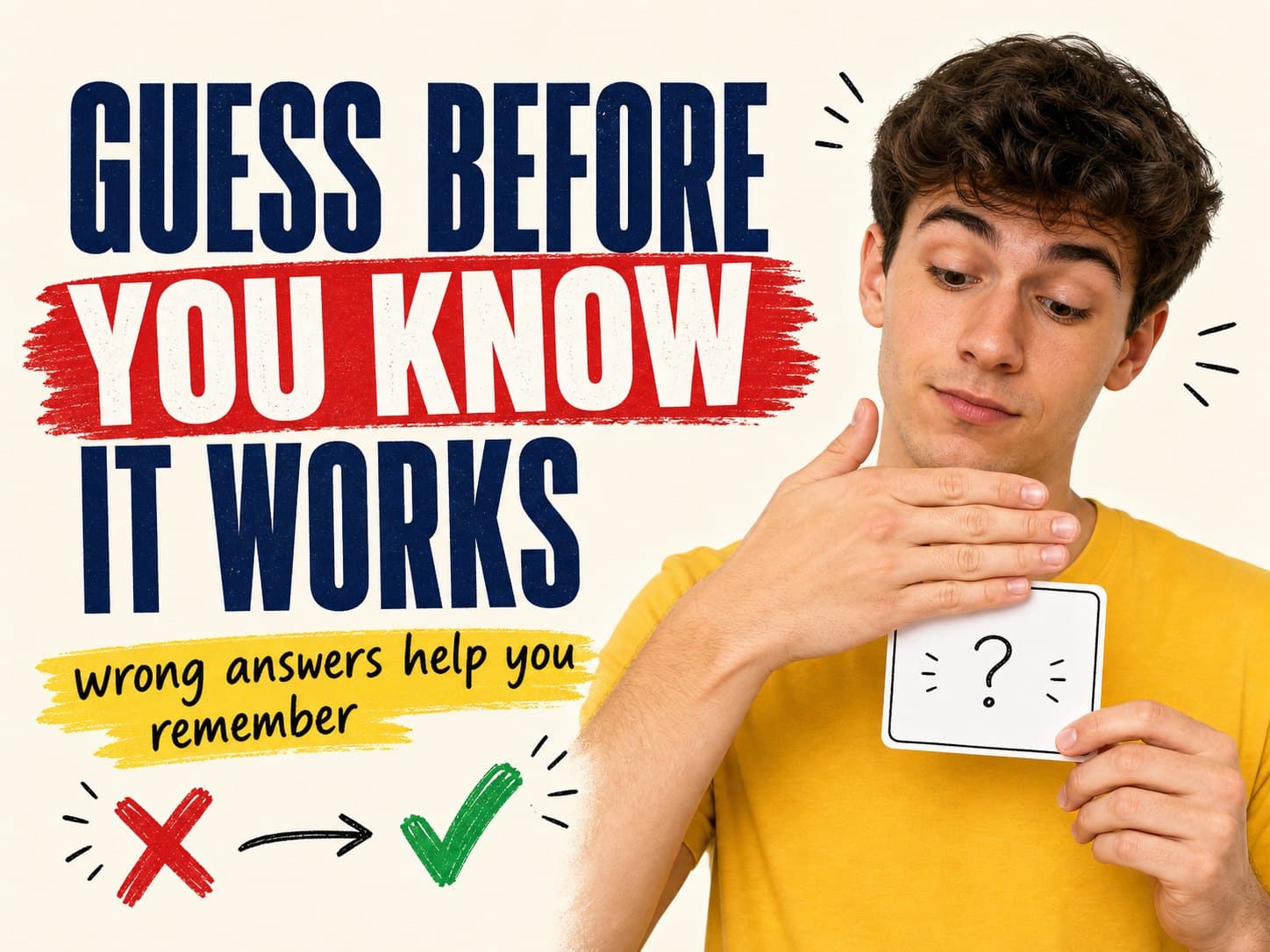
If you have ever felt embarrassed guessing at a German word you clearly do not know yet, on an app, in a class, in your own head while reading a sign, you have been doing something more useful than you realized. A study out of the National University of Singapore, published in March 2026, gives the clearest evidence yet that attempting a wrong answer before you are told the right one builds stronger memory than simply reading the correct pairing and moving on.
This matters for anyone working through vocabulary for a Goethe exam, a visa interview, or just daily survival German, because it points at a habit worth changing today, not a distant theory.
The study, in plain terms
Assistant Professor Steven Pan and graduate student Tabitha Chua at NUS ran four separate experiments with 341 adults who had no prior Spanish knowledge. Everyone learned the same set of Spanish nouns using pictures, but by two different methods.
One group guessed first. They saw a picture and a set of word options, or a word and a set of picture options, made their best guess, then immediately got told whether they were right and what the correct answer was. The other group simply studied the correct pairing from the start, no guessing involved, same amount of exposure time.
Later, both groups were tested on recall and recognition. The guessing group did better across the board, in both directions, word to picture and picture to word. The people who guessed first, even when they guessed wrong, ended up remembering more.
Why a wrong guess helps at all
The explanation Pan gives is that guessing forces your brain to search its own memory before it has anything solid to find. That search, even an unsuccessful one, primes the brain to lock onto the correct answer more firmly once it arrives. Reading a word and its meaning passively does not require that search. You recognize it, you feel like you know it, and then it slips.
This is a cousin of something researchers have understood for a while about testing yourself instead of rereading, but this particular study is the first to test it specifically on the picture matching format that most language apps are actually built around. That is a meaningful gap to close, because until now the evidence for pretesting came mostly from plain word pairs and text passages, not the visual guessing exercises millions of people do every day on their phones.
Your app was already doing this. You may have been fighting it
If you have used Duolingo, Babbel, or almost any vocabulary app, you have already done hundreds of these guess first exercises. The uncomfortable part is that a lot of learners quietly undermine the method without realizing it. People wait to feel confident before answering. They peek at the options longer than needed, or scroll back to check something before committing to a guess. All of that removes the exact mental search the research says is doing the work.
If your German has stalled somewhere in the early stages, guessing badly is not the sign of a problem. Guessing carefully enough that you rarely feel wrong might be the actual problem. That plateau shows up for different reasons at different stages, and vocabulary guessing habits are only one piece of it.
How to actually use this
A few adjustments, based directly on what the study tested:
- Answer before you feel ready. If a word or picture is in front of you, commit to a guess within a couple of seconds rather than studying it first. The guess is the exercise, not a formality before the real learning starts.
- Do not treat a wrong guess as wasted time. It is doing the priming work the study measured. Move straight to the correct answer and keep going, no need to dwell on the miss.
- Practice in both directions. See the German word and guess the meaning, then separately see the meaning or picture and guess the German word. The study found the benefit held in both directions, and most self study skips one of them.
- Get the feedback immediately, not later. The effect depends on seeing the correct answer right after your guess, while the search is still active in your head. Batching corrections at the end of a session loses most of the benefit.
- Apply it beyond flashcards. Before checking a translation app, guess the German word yourself first, even a bad guess. Before your teacher gives you a case ending, try one. The mechanism is not specific to apps.
This is the same logic behind how Germanly builds its practice exercises around guessing with instant feedback rather than passive vocabulary lists, precisely because studies like this one back up why that format works better than reading a glossary.
One caveat worth knowing
The study used adults with zero prior Spanish knowledge learning nouns from pictures, a fairly narrow and controlled setup. It does not tell you that guessing helps with grammar rules, verb conjugation, or listening comprehension in the same way, and Pan's team has not claimed that either. Treat this as strong evidence for vocabulary acquisition specifically, not a blanket theory for every part of learning German.
It is also not a reason to guess randomly and hope. The benefit came from a genuine attempt, using whatever partial knowledge you already had, followed immediately by correction. Wild guessing with no attention to the feedback afterward is not what the researchers tested.
The takeaway
Most people treat not knowing an answer as a reason to hold back. This study is a reasonably strong argument for the opposite. If you are somewhere between A2 and B1, staring down a Goethe exam or a visa deadline, the fastest path through your vocabulary list is probably not more careful review that feels correct. It is more guessing, more often, followed by an honest look at what you got wrong.
If spaced review is already part of your routine, this pairs directly with why your German vocabulary sticks better on the right review schedule. And if you have relied on an app to get you this far, it is worth understanding where that app format tends to run out of road once you are past the basics.
Start your own German story
A1 to B2 — vocabulary, grammar, real audio and AI feedback. First three lessons free.