The German Words You Already Know (Even Though No One Told You)
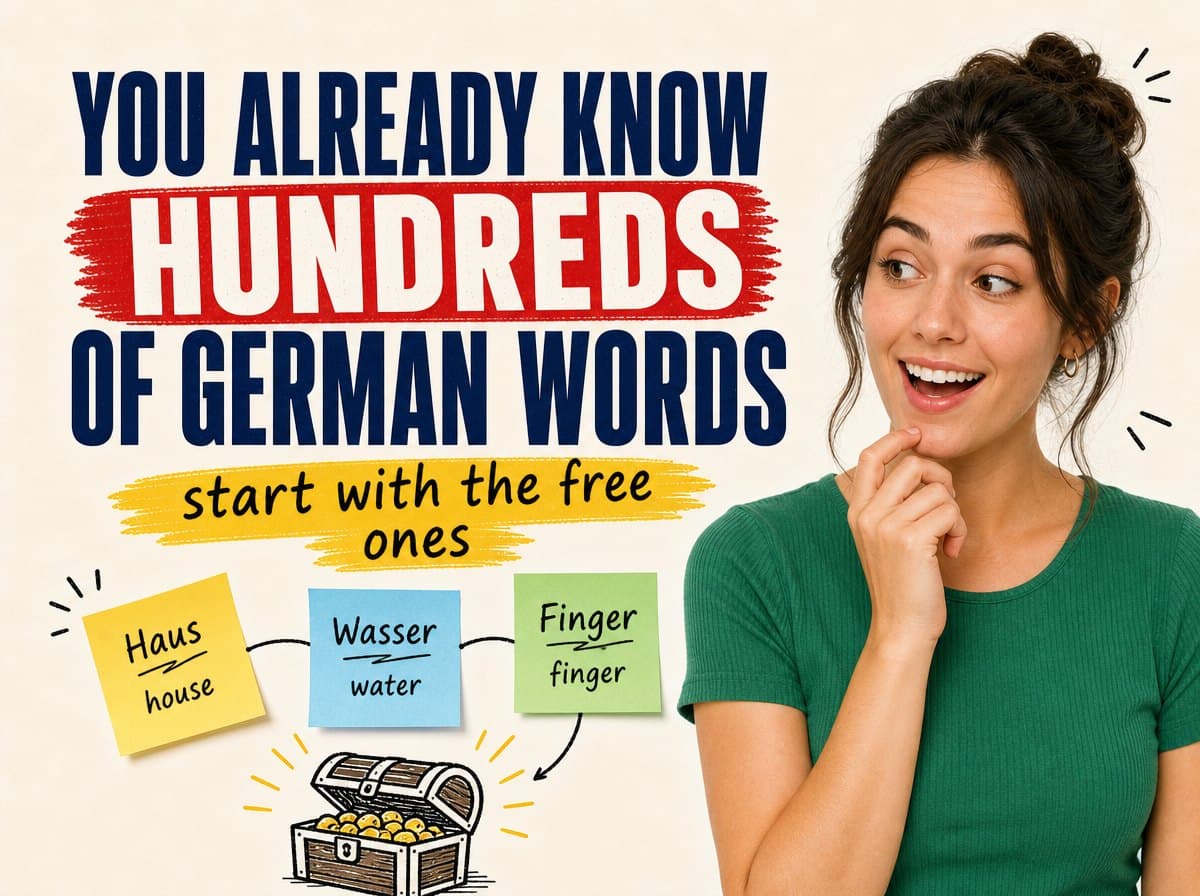
Say this sentence out loud: my hand has five fingers, my arm is warm, and my house has a garden. Hand, finger, arm, warm, garden. Every one of those words is close enough to the German version that you would recognize it cold: Hand, Finger, Arm, warm, Garten. Nobody mentions this in week one of a German course, and honestly, it should be the first five minutes.
Why the two languages sit closer than they feel
English and German both grew out of the same West Germanic branch. Before 1066, English looked and sounded a lot more like German than it does now. Then French flooded in for a few centuries and buried a huge layer of the original vocabulary under Latin sounding words, which is why "commence" feels more familiar to English speakers than the older, more Germanic "begin." German never went through that flood. It kept building on the older layer, and that older layer is still sitting there, waiting for you to notice it.
A study published this year in the Journal of Education Research looked specifically at this overlap for learners preparing for Ausbildung programs, and found that people who were shown the lexical and sound patterns directly picked up new vocabulary faster than those left to spot the connections on their own. That matches what I've seen with learners who get this pointed out early versus the ones who spend six months treating every German noun as a completely foreign object.
The sound shift pattern that unlocks hundreds of words
Roughly 1,500 years ago, German went through a set of consonant changes that English never had. Once you know the four or five common ones, you start predicting German words instead of memorizing them cold.
- English p often becomes German pf: apple becomes Apfel, pepper becomes Pfeffer, pound becomes Pfund.
- English t in the middle or end of a word often becomes s, ss, or ß: water becomes Wasser, foot becomes Fuß, salt becomes Salz.
- English k often becomes German ch: make becomes machen, book becomes Buch, milk becomes Milch.
- English d often becomes German t: good becomes gut, bread becomes Brot, cold becomes kalt.
And plenty of words did not shift at all. Hand, Arm, Finger, Nase, Haus, Maus, Garten, Winter, Sommer, Butter, Gold, Silber, Glas, and Name are the same word wearing a different accent. That is not a small pile of overlap. It is easily a few hundred everyday words you can recognize on sight the first time you meet them, once you know to look for the pattern instead of waiting to be told the meaning.
Where it backfires: the false friends
Some words look like a perfect match and mean something else entirely, and those are the ones that actually embarrass you, because your brain trusts the resemblance without checking.
- Gift means poison, not a present. A present is Geschenk.
- Bekommen means to receive or get, not to become. Become is werden. This single mix up produces more confused sentences from English speaking learners than almost any other word, because "bekommen" sounds and looks so close to "become" that your brain reaches for it automatically mid conversation. Say "Ich bekomme müde" and you have just announced you are receiving tired, not becoming tired.
- Bald means soon, not lacking hair.
- Rat means advice. The rodent is die Ratte.
- Chef means boss or manager in any office, not specifically someone who cooks.
- Handy means mobile phone, not convenient.
- Also means so or therefore, not in addition. "Too" or "as well" is auch.
These aren't obscure trivia. They're the handful of words that show up constantly in real conversation, which is exactly why they cause real damage instead of staying a fun fact.
How to actually use this instead of just noticing it
- When you hit a new German word, spend two seconds checking whether it is a near cognate before treating it as brand new vocabulary. Water and Wasser, good and gut, do not need five spaced repetition reps to stick. They need one, maybe two.
- Learn the sound shift patterns as a small set rather than word by word. Four or five swaps cover a surprising share of basic vocabulary, and once your ear catches one pair, it starts catching the rest on its own.
- Keep a short, personal false friends list as you run into them, not a downloaded list of a hundred you will never open again. The words that actually trip you up in conversation are usually the same eight or ten, and a short list you actually review beats a long one that sits in a notes app forever.
This is part of why Germanly's vocabulary drills group words by pattern instead of dumping everything into one long alphabetical list. For an English speaker, four hundred new German nouns might really only be forty patterns and a short list of exceptions, and treating it that way changes how fast the vocabulary actually sticks instead of leaking out a week later.
The honest limit of this trick
None of this touches grammar. Recognizing that Wasser and water share a root does not tell you Wasser is neuter, and it does nothing for word order or case endings, which follow rules English never had in the first place. If gender and case are the part actually slowing you down, we broke those down separately in The German Case Mistakes That Aren't Actually Your Fault, and if it's specifically the articles that keep slipping out of memory, Why You Keep Forgetting German Articles covers the review schedule that actually fixes that.
Vocabulary recognition will not carry a full sentence by itself, but it clears out a lot of dead weight early. The hours you would have spent drilling four hundred flashcards can go toward the parts of German that are genuinely new: the gender, the case, and the word order that puts the verb wherever German feels like putting it that day.
Start your own German story
A1 to B2 — vocabulary, grammar, real audio and AI feedback. First three lessons free.