You Have About Eight Weeks Before Winter Semester Starts. This Is the German You Actually Need First
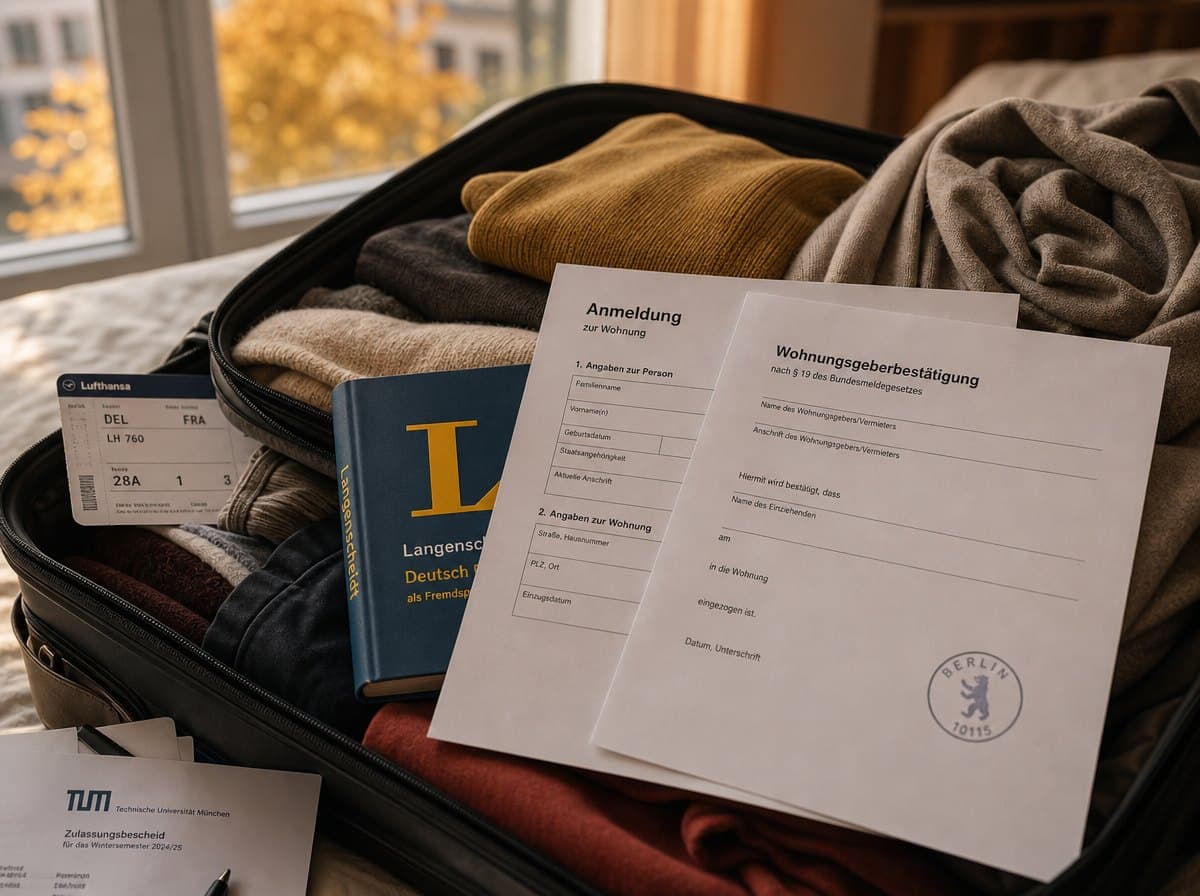
If you have a confirmation letter for a German university's winter semester sitting in your inbox, you are about eight weeks from landing. Most programs start the first week of October, and that means late August or early September flights, blocked account transfers going through, and a lease you have not signed yet.
Here is the part almost nobody warns you about. The German that got you the B1 certificate for your visa is not the German you will use in your first two weeks on the ground. Exam German is built around reading comprehension passages and structured speaking prompts. Arrival German is a landlord texting you in dialect about a viewing time, a Bürgeramt clerk speaking fast because they have forty appointments today, and a bank employee asking you three follow up questions you did not prepare for.
The gap nobody tells you about until you are standing in it
A B1 certificate proves you can handle formal, slowed down German in a testing environment. It does not automatically prepare you for German spoken at native speed, full of regional accent, abbreviations, and bureaucratic shorthand that no textbook covers. We wrote about this gap in more general terms in our breakdown of what B1 actually takes to reach, and the arrival period is where that gap shows up fastest and hurts the most, because you have no time to look words up mid conversation at a Bürgeramt counter.
The good news is that arrival German is narrow. You do not need broader vocabulary. You need depth in about five specific situations, and eight weeks is genuinely enough time to get functional in all of them if you stop spreading your practice thin across general review.
The five situations that will actually happen to you
Anmeldung at the Bürgeramt. This is your address registration, and German law gives you fourteen days after moving in to complete it. In Berlin, Munich, and Hamburg, appointment slots can run two to four weeks out, so you often book this before you have even landed. The clerk will ask about your Wohnung, your Vermieter, and want your Wohnungsgeberbestätigung, a landlord confirmation letter. Knowing these three words cold, plus the phrases for "I have an appointment" and "here are my documents," saves you from a stalled appointment.
Releasing your blocked account. Your Sperrkonto holds roughly 11,904 euros for the year and releases at 992 euros a month. The bank will walk you through activating withdrawals, and the emails and portal instructions are entirely in German unless you specifically ask for English, which not every bank offers. You need enough German to read a banking interface without guessing.
Opening or activating a regular account and SIM contract. Different vocabulary from the blocked account conversation: Vertragslaufzeit, Kündigungsfrist, monatliche Kosten. Salespeople move fast through these terms because they say them fifty times a day. You will not have time to translate in your head.
WG viewings and the Hausordnung. If you are searching for a shared flat, you are competing with other applicants and often meeting the current tenants for a short viewing. This is a conversation, not a form. You need to be able to talk about yourself, ask about the Hausordnung, the house rules on quiet hours and cleaning, and understand the answer without asking three times.
Registering with a Hausarzt. Not urgent in week one, but worth doing before you actually need it. Explaining symptoms in German under stress is a different skill than describing your health history in a calm classroom exercise.
Eight weeks is enough, if you stop reviewing and start rehearsing
Here is a plan that fits around packing and paperwork rather than competing with it.
- Weeks one and two: pull the exact vocabulary and phrases for each of the five situations above. Not general vocabulary lists. The specific words a Bürgeramt clerk or a landlord will actually use.
- Weeks three through five: practice each situation as a spoken exchange, out loud, with someone correcting you in real time or with audio that matches how Germans actually speak at pace, not the deliberately slowed down audio most textbooks use.
- Weeks six and seven: run through the scenarios again but add friction. Have someone interrupt you, ask a follow up question you did not expect, or speak faster. This is what actually happens at the counter.
- Week eight: light review only. Do not cram new material the week you are packing a suitcase and saying goodbyes.
This is the kind of practice that scenario based courses do better than general grammar review, and it is why Germanly built modules around exactly these situations rather than around abstract vocabulary lists. Rehearsing a Bürgeramt conversation before you have one changes how the actual appointment feels.
Stop doing this one thing
If your current routine is flashcards and grammar drills three months before your flight, that was the right call in June. It is the wrong call now. Grammar accuracy matters far less in week one of Germany than the ability to understand a fast answer and respond without freezing. Shift your practice from recognition, reading and understanding when you have time to think, to production under pressure, speaking and reacting in real time. That shift alone will do more for your first two weeks than another month of vocabulary lists.
One more thing worth doing before you fly: reread the update on what changed with student visa appeals if your enrollment or program format has any ambiguity at all. Immigration offices have gotten less forgiving this year, and understanding a permit renewal notice in German, not a translated summary, is exactly the kind of arrival week skill this piece is about.
You picked a program, you got the visa, you found a flight. The last eight weeks are for making sure the version of German you show up with actually works on a Tuesday morning at the Bürgeramt, not just on an exam sheet.
Start your own German story
A1 to B2 — vocabulary, grammar, real audio and AI feedback. First three lessons free.