Starting German from zero: a realistic 30-day plan
When I started learning German, I lost my first two weeks to a classic mistake: collecting resources instead of learning. Five apps, three YouTube playlists, a grammar PDF I never opened. If that sounds familiar, this post is the plan I wish someone had handed me on day one.
One promise up front: nothing here says "fluent in 30 days." That is not a real thing. What IS real: in 30 days you can greet people, introduce yourself, count, order food, ask simple questions, and read basic signs. That is A1 territory, and it feels amazing.
Week 1: Sounds and survival phrases
Do not start with grammar. Start with your mouth and ears.
- Learn how German letters sound — especially ä, ö, ü, ß, w, v, z. German spelling is honest: once you know the sounds, you can pronounce almost any word you read.
- Memorize 15 survival phrases: Hallo, Danke, Bitte, Entschuldigung, Wie geht's?, Ich verstehe nicht, Sprechen Sie Englisch?
- Say everything OUT LOUD. Whispering in your head does not count.
Daily time: 15–20 minutes. The goal this week is comfort, not knowledge.
Week 2: The first real sentences
- Learn sein (to be) and haben (to have) — the two verbs German cannot live without.
- Learn the pronouns: ich, du, er, sie, es, wir, ihr, sie.
- Build tiny sentences: Ich bin müde. Du hast ein Auto. Wir sind hier.
- Start numbers 1–20. Germans use numbers constantly — prices, times, bus lines.
The trick that worked for me: narrate your day in baby German. "Ich trinke Kaffee. Ich bin im Bus." Nobody hears it, and it builds the sentence reflex.
Week 3: Nouns and their genders
Here is the thing everyone warns you about: every German noun has a gender — der (masculine), die (feminine), das (neuter). Two rules saved me:
- Never learn a noun without its article. Not "Tisch" — always "der Tisch." Your memory stores them together or not at all.
- Do not try to understand WHY a table is masculine. There is no why. Accept it and move on.
Add 10 nouns a day with articles: family words, food, things in your room. By the end of the week you have 70 nouns that actually matter.
Week 4: Put it together
- Learn the regular verb pattern (lernen → ich lerne, du lernst, er lernt). One pattern unlocks hundreds of verbs.
- Learn question words: wo, was, wann, wie, warum.
- Practice real exchanges: introducing yourself, asking where something is, ordering.
- Listen to slow German audio, even if you catch 30%. Your ears need mileage more than your eyes do.
What to skip in month one
- Cases (Akkusativ, Dativ). You will need them, but not yet. Understanding "der becomes den" means nothing until you have sentences to use it in.
- Perfectionism about der/die/das. Germans will understand "der Milch" even though it is wrong. Keep talking.
- Any resource that promises fluency fast. Fluency is a year-scale project. A great first month is the goal here.
The only rule that actually matters
Fifteen minutes every day beats two hours every Sunday. Language learning is compounding: daily reps move words from "I saw that once" to "I own that." Miss a day? Fine. Miss three? That is how it dies.
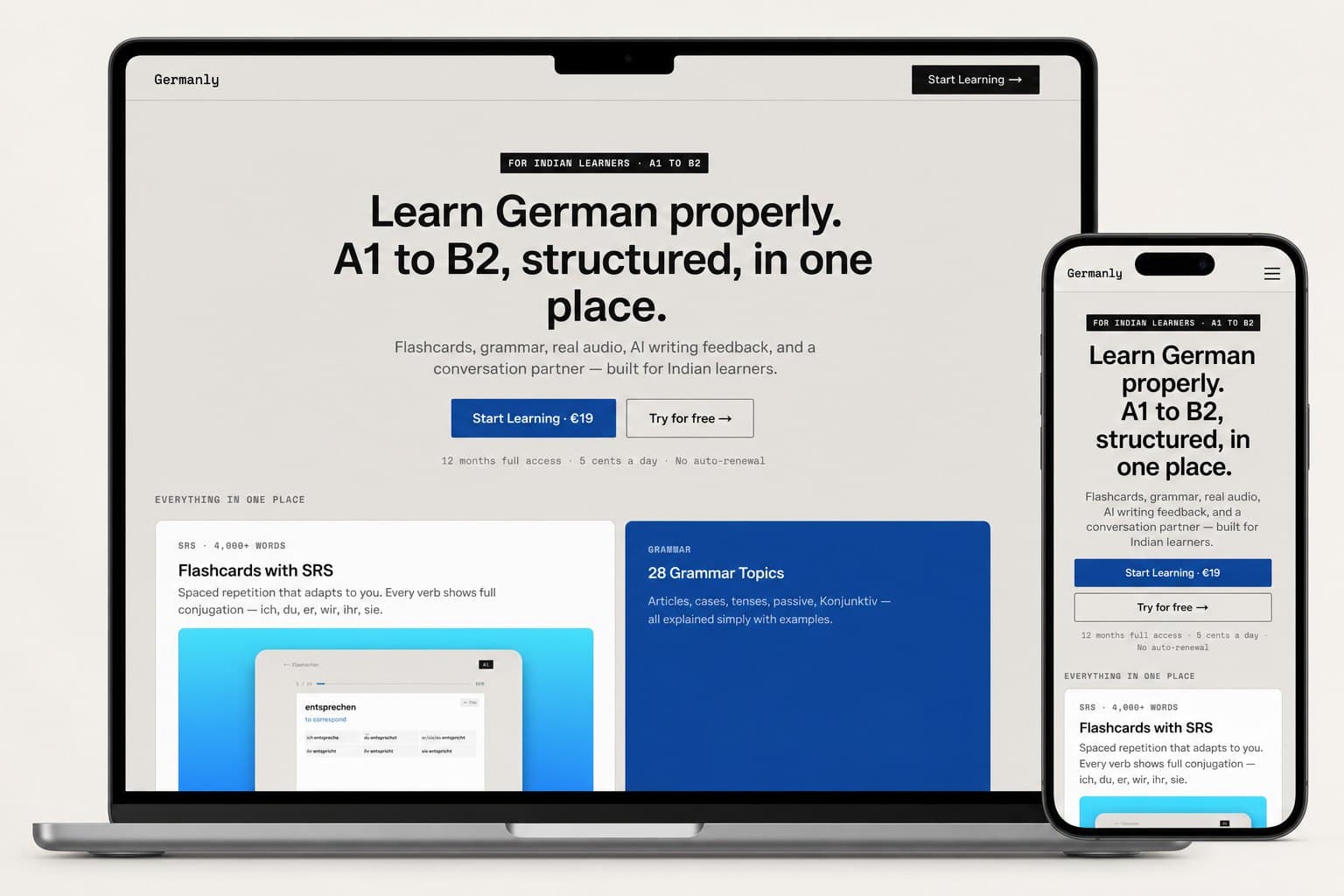
That is also why I built Germanly the way I did — a daily plan that tells you exactly what to study next, so you never waste your 15 minutes deciding what to do. The first lessons are free, and they follow more or less exactly the path above.
Whatever tool you use: start today, start small, and say it out loud. Viel Erfolg! 🇩🇪
Start your own German story
A1 to B2 — vocabulary, grammar, real audio and AI feedback. First three lessons free.