Scientists Found How Bilingual Brains Store Meaning. It Changes How You Should Learn German Vocabulary
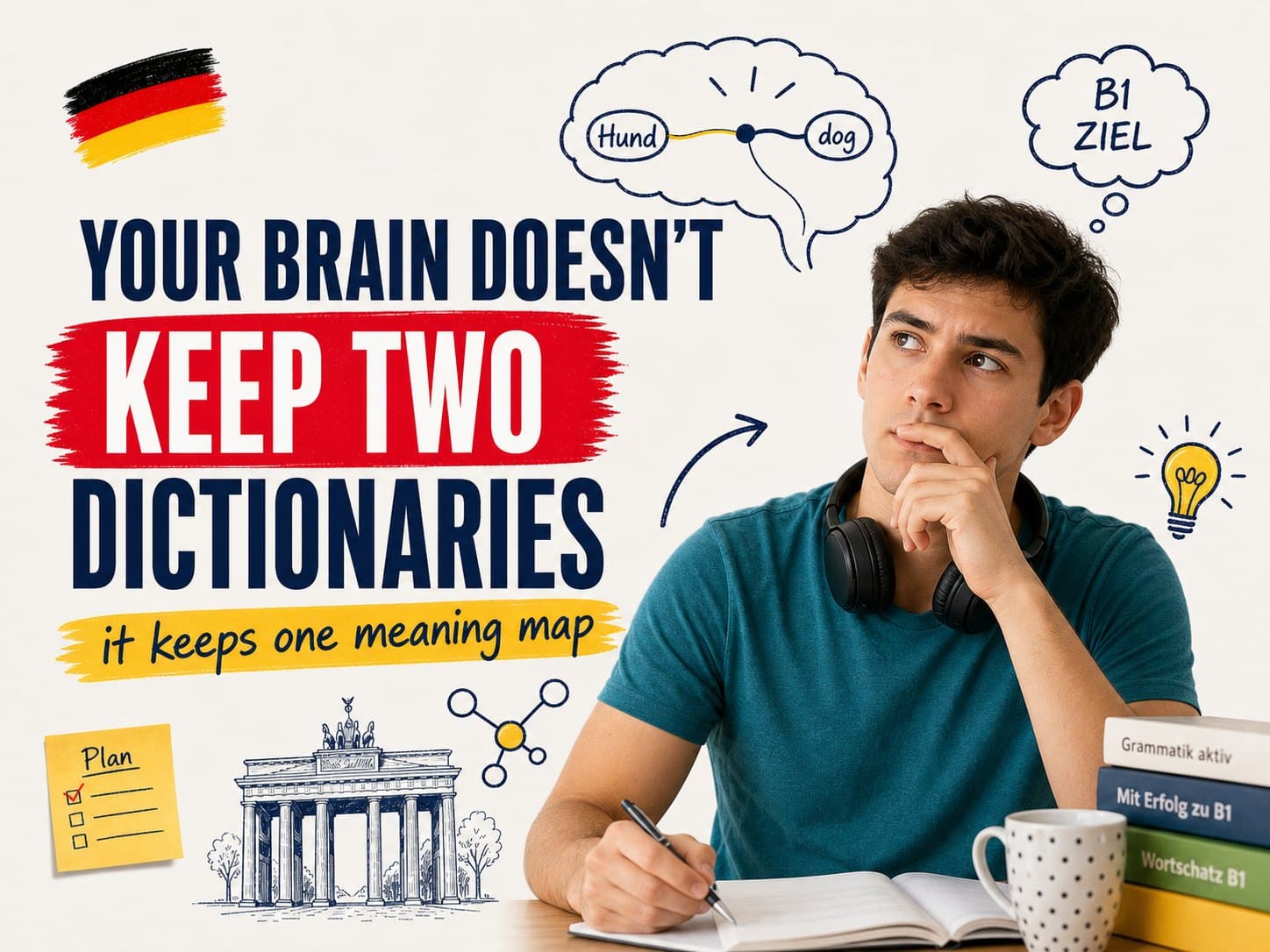
For a long time, the assumption about bilingual brains was fairly intuitive. Learn a second language and you build something like a second dictionary next to the first one, a parallel set of word files your brain flips between depending on which language you're using. A study published on June 24, 2026 in the journal Cell suggests that picture is basically wrong, and the actual mechanism has real implications for anyone learning German as a second or third language.
What the researchers actually did
Researchers at Rice University and Baylor College of Medicine got a rare kind of access most language studies never get. Four fully bilingual English and Spanish speakers were already undergoing neurosurgery for epilepsy treatment, which meant electrodes were already placed deep in their brains for clinical reasons. The team used that window to record activity from hundreds of individual neurons in the hippocampus while these patients listened to stories, read phrases aloud, and had spontaneous conversations in both languages.
What they found surprised even the researchers. Most individual neurons did respond differently depending on which language was being used. There was no large population of dedicated "translation cells" firing identically for the Spanish word tierra and the English word Earth. But when the team mapped the overall pattern of how concepts related to each other in neural space, that pattern stayed remarkably stable across both languages. The distance and relationship between concepts like ocean, sky, and mountain looked the same whether the person was thinking in English or Spanish, even though the specific neurons doing the work were different in each case.
Sameer Sheth, one of the study's senior authors, described it this way: the brain appears to store meaning in a language independent format, where different languages access a shared conceptual map rather than building entirely separate representations of the world. His fellow senior author Benjamin Hayden called it a shared semantic geometry, a system where each language gets its own neural readout but the underlying structure of what things mean to each other stays constant.
Why this matters more than it sounds like it should
Here's the part that's genuinely useful if you're grinding through German vocabulary right now. The old dictionary model implies you need to build German almost from scratch, as a second, isolated system running parallel to your first language. That framing pushes people toward vocabulary lists that pair a German word with its English translation and not much else, then drill the pairing until it sticks.
The research points somewhere different. If your brain already holds a rich, well organized map of what things mean and how they relate to each other, built up over years in your first language, the job of learning German vocabulary isn't recreating that map. It's attaching new labels to a structure that mostly already exists. Learning German words as tags for concepts you've already spent a lifetime organizing should, in theory, be a lighter lift than the "build it all again" model suggests, and it explains why fluent bilinguals can switch languages mid sentence without visibly reloading anything.
This lines up with something we've written about before when it comes to cognates, the German words you already half know because English borrowed from the same roots. Cognates work because your brain is recognizing an existing concept through a new label, not building a new one. The Cell study suggests that mechanism isn't limited to cognates. It's closer to how vocabulary learning works in general, just more visible when the words already look alike.
What actually changes in how you study
A few concrete shifts follow from this, and none of them require more study time, just different targets for the time you already spend.
- Learn words in concept clusters, not alphabetical or random lists. If your brain organizes meaning by relationship, group new vocabulary the same way. A session on kitchen items, weather, or emotions gives your brain a structure to hang new labels onto. A random daily word list from an app doesn't.
- Attach new German words to the concept directly, not to the English word. When you learn Angst, picture or recall the actual feeling, don't just memorize that it maps to "fear." The faster you connect the German label straight to the concept, the less your brain has to route through English every time you want to say it.
- Use images, scenarios, and personal memory rather than pure translation pairs. A flashcard that shows a photo of rain and the word der Regen is closer to how the brain actually stores meaning than a card that just says "rain = der Regen."
- Don't panic about keeping the languages "separate." The neurons doing the work are different for each language anyway. Mixing languages while you study, or thinking partly in English while producing German, isn't corrupting some clean system. That system was never fully separate to begin with.
The honest caveat
Four participants is a small sample, and all four were English and Spanish bilinguals recorded through electrodes placed for an unrelated medical reason, not volunteers recruited for a language study. The researchers are upfront about that limitation and say future work needs to confirm whether the same pattern holds for other language pairs, including ones with different writing systems or grammatical structures than English and Spanish. German, with its case system and word order rules that don't map cleanly onto English, might show some differences worth watching for. But the core finding, that meaning is stored in a shared, language independent structure rather than duplicated per language, fits with decades of earlier bilingualism research and gives a solid reason to trust the practical takeaway.
Where this leaves you
If you've been treating German as a completely separate mental filing system from your first language, something to build from zero, this research is a decent reason to stop. Your brain almost certainly is not doing that. It's reusing a map you already have and giving it a new set of labels. Vocabulary work that respects that, grouping by concept, connecting directly to meaning instead of routing through translation, tends to stick faster and surface faster in conversation.
That's also the logic behind how Germanly structures its vocabulary lessons around themes and real situations instead of isolated word lists, since it matches how your memory actually organizes new material rather than fighting against it. If you're curious about the memory side of why words fade a few days after you learn them even with a good method, our piece on the forgetting curve and spaced repetition covers the other half of this puzzle.
Your brain was never planning to build German from nothing. It already did most of the work years ago. The trick now is learning in a way that lets it use that.
Start your own German story
A1 to B2 — vocabulary, grammar, real audio and AI feedback. First three lessons free.