Your German Level Is Worth More Chancenkarte Points Than Most Applicants Realize
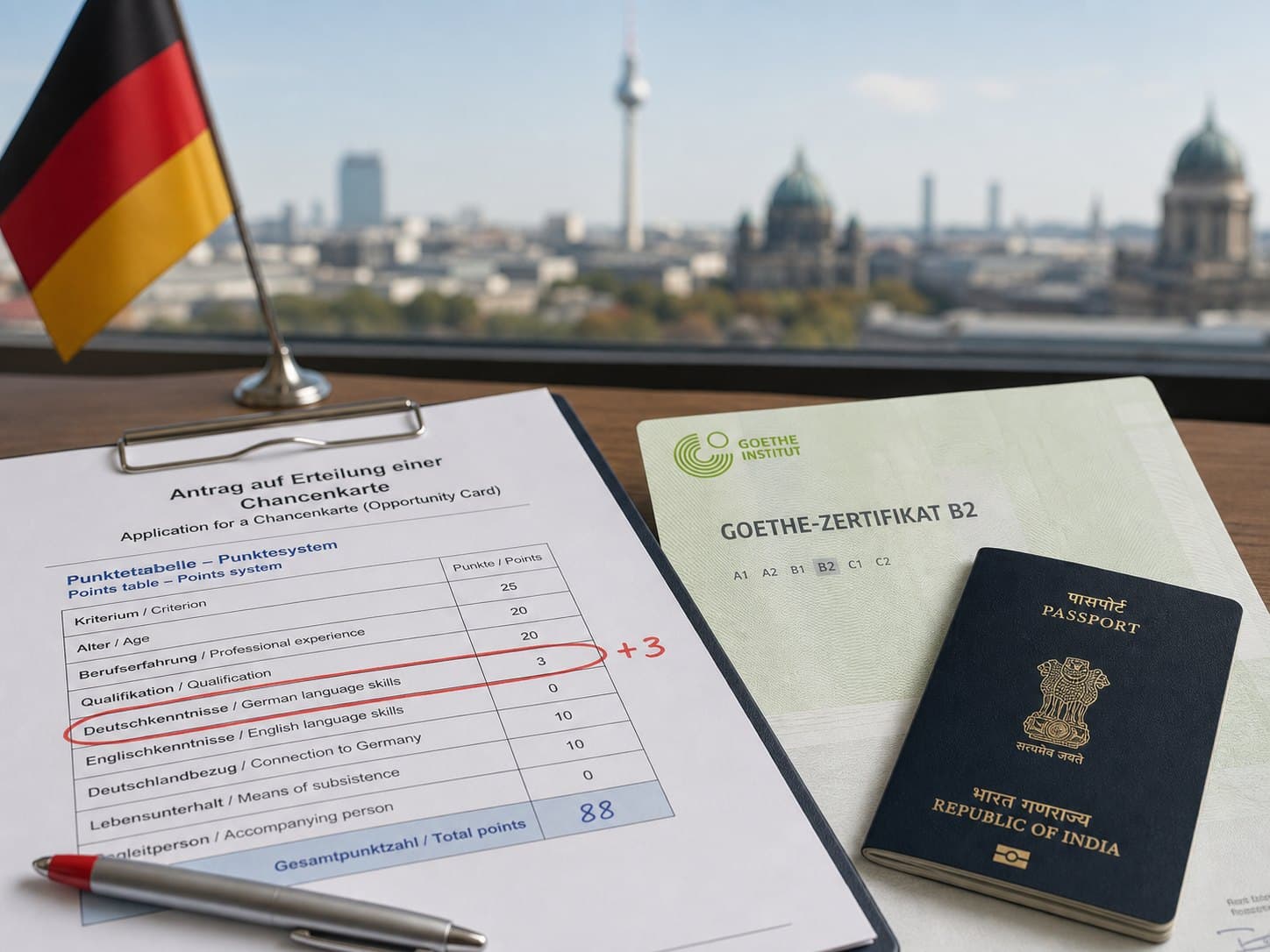
Every few weeks someone tells me they are applying for the Chancenkarte and treating German as a box to tick after the real work is done. They assume the points system rewards age, experience, and qualifications, and that language is a minor add on if there is time left over. For a lot of applicants that assumption is exactly backwards, and it can be the difference between a visa and a rejection letter.
What the points system actually rewards
If your foreign degree or vocational qualification is not fully recognized in Germany yet, you apply through the points based route, and you need a minimum of six points to qualify. The grid looks like this:
- Age: under 35 gets two points, 35 to 40 gets one point, 41 and older gets zero
- Professional experience: two years of relevant work in the last five years is worth two points, five or more years in the last seven years is worth three
- Language skills: German A2 is one point, German B1 is two points, German B2 or higher is three points, and English C1 or native English adds one more point on top of your German score, for up to four points total
- Partial recognition of your qualification: four points, the single biggest category on the whole grid
- Shortage occupation, such as IT, engineering, healthcare, or skilled trades: one point
- A previous legal stay in Germany of at least six continuous months: one point
- A spouse or registered partner who also meets the requirements and applies with you: one point
Six points gets you in the door. Anything past that just makes the file cleaner.
The category almost nobody plans around
Look at that list again and ask which lines you can actually move yourself, on your own schedule, without waiting on a government office or an employer. Age only goes one direction. Professional experience needs literal years to accumulate. Qualification recognition depends on an assessment from ZAB and you have limited say in the outcome. A previous stay in Germany either happened or it didn't.
Language is different. It is the one category where the number on the page reflects a decision you made and followed through on, and it is worth up to four points if you push past the minimum. Most applicants stop at German A1, because A1 is the legal floor for the points route. Stopping there means leaving two full points on the table compared to reaching B2, and two points is often the entire gap between qualifying and not.
A worked example
Take Priya, 37, a marketing professional with two years of relevant experience, no shortage occupation, no prior stay in Germany, and no partner applying alongside her.
Her age bracket gives her one point. Her experience gives her two points. That's three points before language even enters the picture.
If she stops at German A2, she adds one point. Total: four. She does not qualify, and nothing else on her profile can close that gap without more time passing or a job offer changing her situation entirely.
If she reaches German B2 instead, she adds three points. Total: six. She qualifies through language alone, without touching age, experience, or anything else on the grid.
Same person, same job history, same everything except one number on a language certificate. That's not a small detail buried in an appendix. That's the entire outcome of the application.
Why the timing catches people off guard
The mistake is not usually a lack of awareness that language points exist. It's underestimating how long B2 actually takes to reach properly, and starting the exam booking process too late to matter. Goethe Institut slots in India routinely fill within hours of opening, registration typically opens six to eight weeks before the exam date, and a rushed B2 attempt a few weeks before your visa appointment is a bad way to find out you needed more time.
If you already know you are heading toward a points based Chancenkarte application, the honest planning question is not "what's the minimum German requirement." It's "how many months do I actually need to get from where I am now to a B2 I can defend in a follow up interview." For someone starting from A2, that gap is real, and it deserves the same seriousness as gathering qualification documents or booking a blocked account.
This is part of why we built Germanly around finishing a level properly instead of cramming toward a single exam date. A B2 certificate that reflects actual comprehension holds up better under scrutiny than one earned by memorizing exam patterns two weeks before the test, and it's the difference that shows up in exactly the kind of point count Priya's example walks through.
If you're on the EU Blue Card track instead of the Chancenkarte, the same principle plays out differently but just as sharply. We wrote about how B1 German directly shortens the wait for permanent residency for Blue Card holders, which is the same underlying idea: your language certificate is not paperwork, it's a lever with a measurable effect on your legal timeline.
And if B2 feels far away from where you are right now, most people hit a wall around B1 that has very little to do with motivation. We covered why that plateau happens and how to move past it, which is usually the exact stretch standing between an A2 applicant and a B2 one.
The math is simple. The planning rarely is
Six points is not a high bar, and for a lot of applicants German is the cheapest, most controllable way to reach it. The people who get caught out are rarely missing information about the points grid. They're missing the months of runway it takes to turn a certificate level into a real one, and they find that out at the exact moment it's too late to fix. If you're building toward a Chancenkarte application this year, decide now which side of that gap you want to be standing on.
Start your own German story
A1 to B2 — vocabulary, grammar, real audio and AI feedback. First three lessons free.