Duolingo Now Says Its German Course Reaches B2. Your Visa Still Wants a Certificate, Not a Score
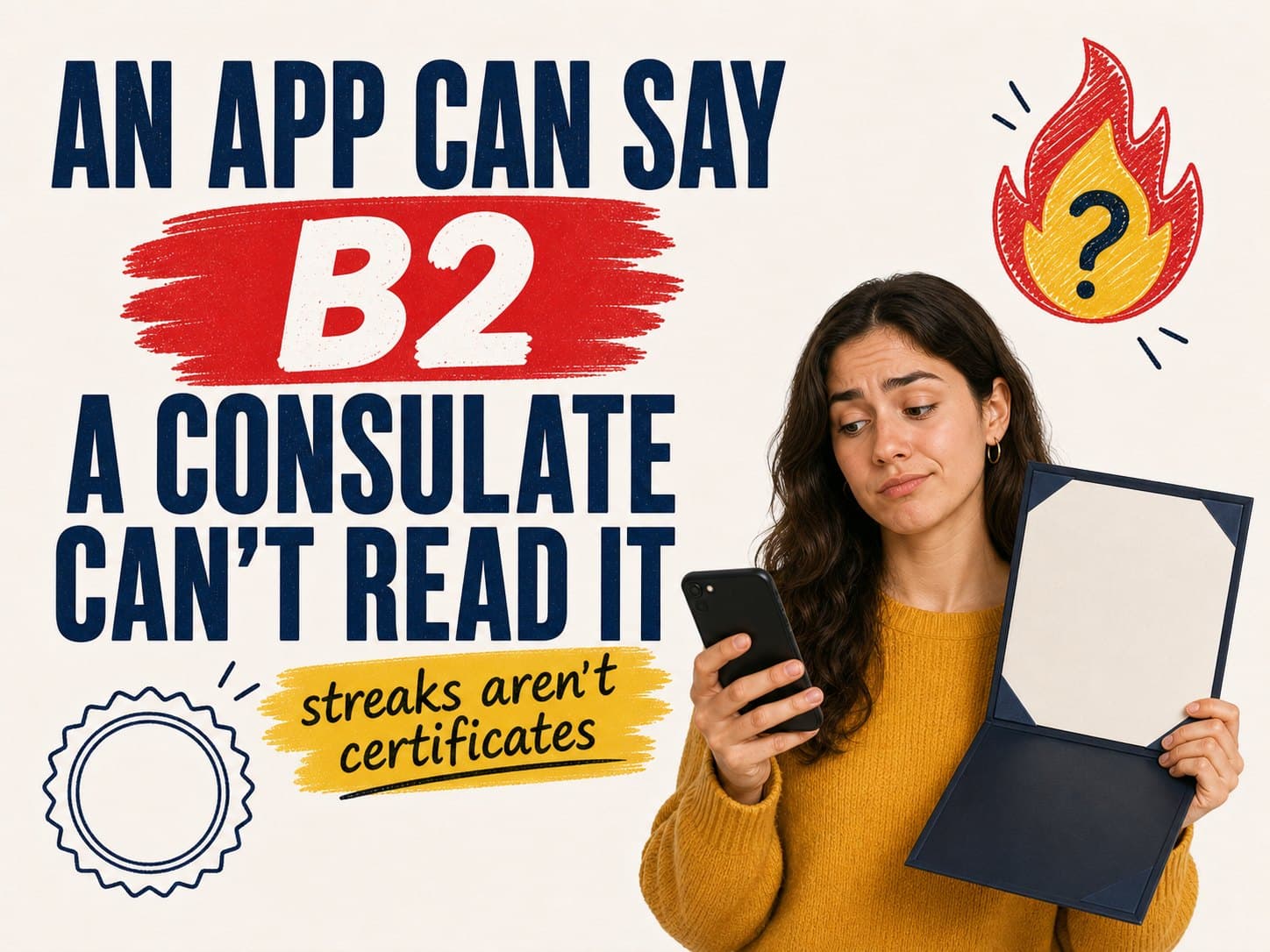
In April, Duolingo announced that its German course now teaches content through B2 on the CEFR scale, a Duolingo Score of 129. Before that update, most learners who finished the entire course topped out around A2, occasionally scraping into low B1. That gap has driven a lot of confusion for people prepping for a German visa, and it is worth being precise about what actually changed and what did not.
If you are studying German to hit a visa deadline, an Ausbildung contract, or a university application, this matters to you specifically. Not because the update is fake. It is real, and it makes the app genuinely more useful than it was a year ago. It matters because "the course now covers B2 content" and "you now have a B2 certificate" are two completely different claims, and the gap between them is exactly where people lose months they did not budget for.
What actually changed in April
Nine of Duolingo's major courses, German included, were extended to cover material through B2 on the CEFR framework. Previously the German course stopped well short of that, which is why so many learners hit a wall around A2 no matter how long their streak ran. The company frames a Score of 129 as putting someone at the "independent user" stage: able to hold a conversation, follow a moderately complex text, and express opinions on familiar topics without constant hesitation.
That is a real jump in content depth. The vocabulary range is wider, the grammar structures get harder, and the exercises push further into the kind of German a B2 exam actually tests. None of that was true of the course a year ago.
What a Duolingo Score does not measure
Here is the part that gets left out of most of the coverage of this update: a Duolingo Score is not a CEFR certificate, and no German authority treats it as one. Visa offices, Ausbildung employers, universities, and the citizenship process all ask for a certificate from a recognized testing body, specifically Goethe Institut, telc, ÖSD, or TestDaF. A screenshot of your app profile showing 129 points has never once appeared on an accepted visa document checklist, and it is not going to start now.
The reason isn't bureaucratic stubbornness. It comes down to what each format actually tests. A CEFR exam puts you in a room, or on a proctored call, and makes you produce spoken and written German under time pressure with an examiner scoring the output. An app score reflects completed exercises, many of which are multiple choice or fill in the blank, built for retention and daily habit rather than live production. A 2026 peer reviewed study on Duolingo's French course found learners' communication skills after one semester were comparable to classroom learners, which is a genuinely strong result. Comparable to a first semester classroom learner is still a long way from what a B1 or B2 exam demands of someone applying for an Ausbildung visa or a Chancenkarte.
Why this trips people up specifically
The timing makes it worse. Someone who downloaded Duolingo in 2025 and got used to the course stopping around A2 has now watched the ceiling move to B2 without necessarily changing how they study. The habit stays the same, thirty minutes a day, mostly tapping through vocabulary drills, while the score climbs into territory that sounds like it should satisfy a visa requirement. It does not, and finding that out a few weeks before a visa appointment is a bad time to learn it.
We wrote about this exact pattern in our earlier piece on Duolingo's old A2 ceiling, and the underlying problem hasn't gone away with this update. It has just shifted further up the CEFR scale. Speaking and listening practice are still easy to skip inside the app, and skipping them is still how people end up with a strong score and a frozen response the first time a Goethe examiner asks them an unscripted question.
What to actually do with the wider course
The expanded content is worth using. It just needs a different frame than "finish the course, get the certificate."
- Treat the Duolingo Score as a rough signal, not a target. It tells you roughly where your passive knowledge sits. It says nothing about whether you can produce that German out loud under exam conditions.
- Book a real exam early enough to find the gap. Sitting a mock Goethe or telc paper while you are still mid course shows you exactly which skills the app isn't building, usually speaking and unscripted listening, while you still have time to fix it.
- Add structured speaking practice on top of the app, not instead of it. The wider vocabulary range is a genuine asset once you're producing it in conversation rather than just recognizing it in a multiple choice question.
- Check which certificate your specific route requires before you assume B1 is the ceiling. As we covered when comparing Goethe and telc, the certificate itself rarely decides your outcome. Having the right one, from a body your visa category actually accepts, booked and in hand before your deadline does.
This is the exact gap Germanly's structured programs are built around, pairing the kind of daily practice apps are good at with deadline aware progress toward an actual recognized certificate, so the number on your screen and the number on your visa file end up meaning the same thing.
The honest version
Duolingo's German course is better than it was a year ago, and if you are starting from zero, the wider B2 content gives you more runway before you outgrow the app. But the update changes what the app teaches, not what a visa office accepts. If your deadline has a certificate requirement written into it, and almost every German visa route does, plan around the exam you need to pass, not the score the app hands you for finishing a lesson streak.
Start your own German story
A1 to B2 — vocabulary, grammar, real audio and AI feedback. First three lessons free.