Your Germany Visa Appointment Sets the Real Deadline. Most People Plan From the Wrong Date
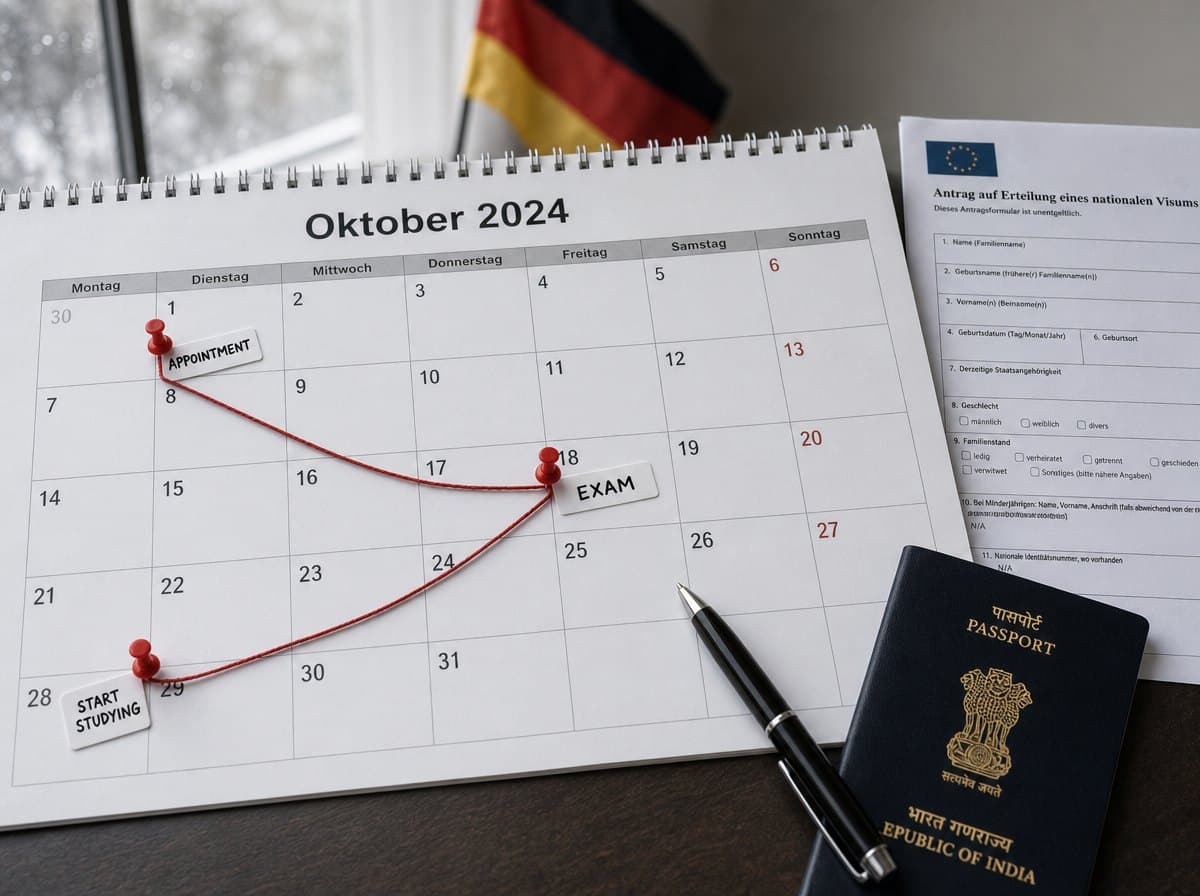
Ask most applicants when their German timeline starts and they will point to the day they enrolled in a course, or the day they picked a start date for their Ausbildung or Studienkolleg. That is the wrong anchor. The date that actually controls everything is the day you can get a visa appointment, and in India that date is often 6 to 12 weeks away from the day you try to book one, not the day you show up ready with your documents.
VFS Global is the sole authorized provider for German visa appointments in India, and current wait times are uneven across the country. Kolkata and Pune applicants have reported getting a slot within 1 to 3 weeks. Delhi and Mumbai, during peak season, have seen 8 to 12 week waits. A new Consular Services Portal has helped cut average processing delays by roughly 15 to 20 percent this year, but the booking bottleneck for National visas is still real, and it does not care whether your German is ready.
This matters because most people build their study plan around the wrong end of the process. They ask "how long until I'm ready for the exam" and work forward from today. The better question is "when do I actually need to walk into that appointment with a certificate in hand," and work backward from there.
Why forward planning fails
Forward planning feels natural because it matches how you experience the work: you study today, you study tomorrow, progress accumulates, and eventually you feel ready. The problem is that "feeling ready" and "having a visa slot available on the date you're ready" are two completely separate timelines that only sometimes line up.
Say you're aiming for a September Ausbildung start. If you assume you can book your appointment whenever your German hits B1, and B1 takes you five months, you might finish studying in July and only then discover the earliest Mumbai slot is ten weeks out. That pushes your actual appointment into late September, past your intake date, for a delay that had nothing to do with your German at all.
The backward math
Start from the date you need to be in Germany and subtract three windows, not one.
- Appointment booking lag. Add 6 to 12 weeks depending on your city and the season. Peak months, especially June through August, run longer than quieter months.
- Visa processing time after the appointment. Budget another 4 to 8 weeks once your file is submitted, longer for Ausbildung and student visas than for tourist visas.
- Buffer for document problems. APS certificates, blocked accounts, and admission letters all have their own lead times, and any one of them running late pushes your appointment date, not just your paperwork.
Add those three windows together and you often land at four to six months before your intended arrival date, before you've counted a single hour of actual German study. If your B1 exam needs to be booked and sat before that appointment, which it usually does for Ausbildung and many student visa categories, your study deadline sits even earlier than that.
What this actually looks like on a calendar
Take a concrete example. If you want to be in Germany by early October for a winter semester or Ausbildung start:
- Work backward 6 weeks for visa processing after the appointment. That puts your appointment date around mid August.
- Work backward another 8 to 10 weeks for appointment booking lag in a high demand city. That puts your booking window in early June.
- Your B1 certificate needs to be in hand before that booking window opens, which means your Goethe or telc exam sitting needs to fall in April or May, not August.
- Counting backward from an April exam, using the roughly 400 study hours B1 typically takes from zero, you needed to start studying by the previous November or December.
Most people doing this math for the first time are surprised by how early the real deadline sits. The appointment bottleneck alone can eat two to three months that never show up when you're only thinking about your German level.
What to actually do with this
A few things follow once you accept the appointment date, not the exam date, as your real deadline.
- Check appointment availability before you build a study plan, not after. A rough sense of your city's current wait time changes what "urgent" means for you specifically.
- Book earlier than feels necessary. If your city is running an 8 week wait and your German won't be exam ready for another 12 weeks, book the appointment slot now for a date that matches your realistic exam timeline, rather than waiting until you feel ready to start looking.
- Treat your exam date as fixed once it's booked, and build your study hours backward from it the way we laid out in our piece on the real hour count behind B1. A moving exam date usually means a moving appointment date, which compounds the delay rather than fixing it.
- Know which visa route you're actually on before assuming B1 is even required. The Ausbildung visa and student visa categories have different language thresholds than the skilled worker route, and getting that wrong wastes weeks you don't have, something we go into in our breakdown of the Ausbildung visa's B1 requirement.
This is the kind of planning Germanly's learners get walked through directly, mapping a study schedule to an actual visa timeline instead of a generic course length, so the exam date on the calendar is one you set on purpose rather than one that got picked for you by an appointment backlog.
None of this is a reason to panic if you're reading this with a shorter runway than you'd like. It's a reason to check your city's current appointment wait this week, today if you can, and build your study plan around the number you find rather than the number you were hoping for. The applicants who get through this process without a last minute scramble are almost never the ones who studied fastest. They are the ones who found out the real deadline early and worked backward from it honestly.
Start your own German story
A1 to B2 — vocabulary, grammar, real audio and AI feedback. First three lessons free.