Goethe Exam Slots in India Vanish in Minutes. Here Is the Registration Window You Cannot Miss
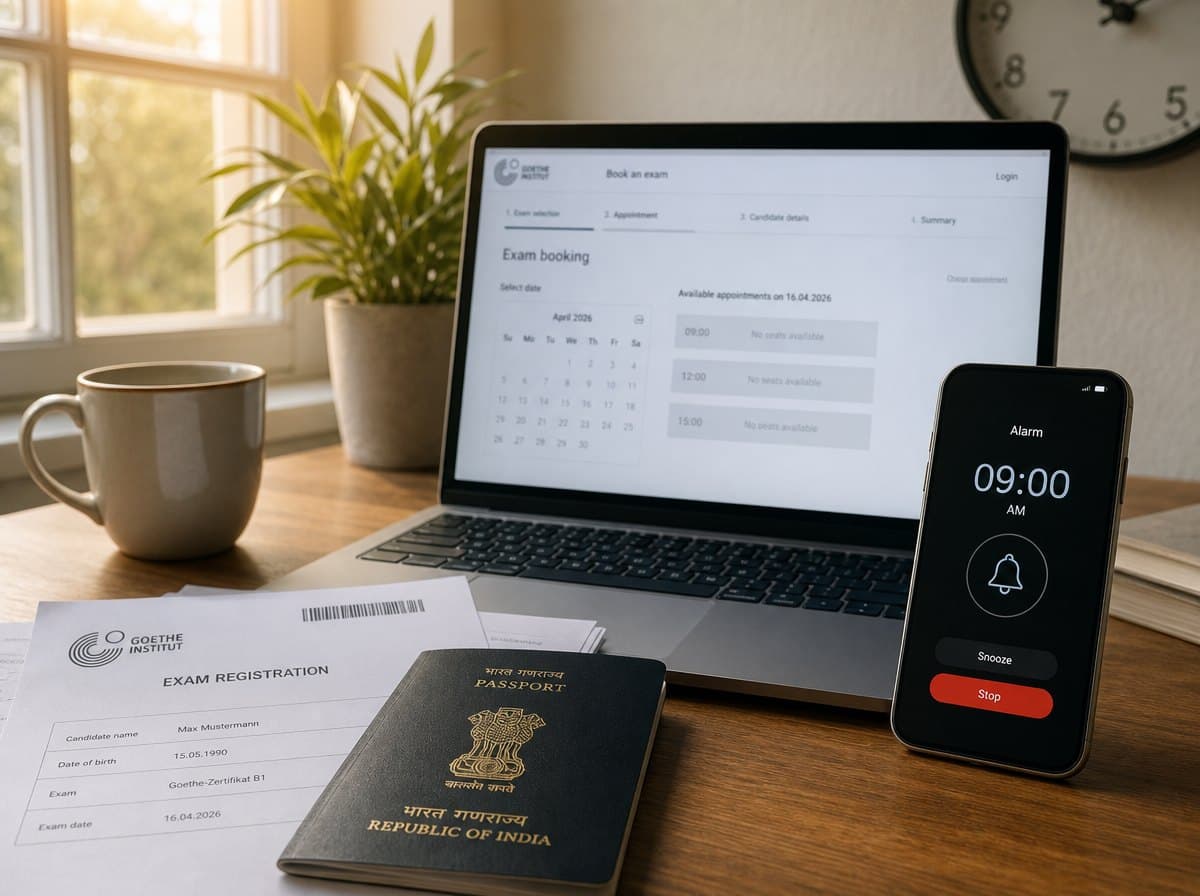
A friend messaged me last week at 9:47 in the morning, furious. She had set an alarm for the Goethe B1 registration opening, refreshed the page at 9:00 sharp, and by 9:12 every slot in Delhi for the next two months was gone. She is not a disorganized person. She just did not know that "registration opens at 9 AM" and "you have until roughly 9:15 to get a seat" are, in practice, the same sentence.
If you are anywhere near a German visa deadline this year, this is worth ten minutes of your attention.
Why the slots disappear so fast
Goethe Institut India runs a fixed number of exam seats per city per sitting, and demand has outgrown supply for a few years running. Delhi, Mumbai, and Bangalore see the worst of it. Multiple people who track this closely report slots vanishing within five to fifteen minutes in those three cities, and mornings tend to go first since most applicants want the earliest available date.
The timing gets worse in certain months. May through July is when the Indian master's applicant cohort and the winter intake visa applicants hit the same registration window at once, so competition for August through October exam dates is sharper than any other stretch of the year. If you are reading this in late July, you are sitting right at the edge of that crunch for the next opening.
When registration actually opens
Registration for a given exam date typically opens six to eight weeks before that date, not the day before, not a rolling window. Goethe publishes a fixed calendar, and each center posts its own opening times on the website ahead of it. That means if you want an October exam, you need to be watching the calendar in early to mid September, not waiting until you feel ready.
This is the part people get backwards. They plan their study timeline around "I will book the exam once I feel prepared," when the smarter order is to book the seat the moment registration opens for a date roughly two months out, then build your preparation schedule to hit that fixed point. A seat you are not fully ready for and can push through with two extra weeks of focused study is a much better problem than no seat at all.
What actually works on the day
A few concrete habits separate the people who get a slot from the people who do not:
- Create your Goethe account and complete your profile at least a week before the opening date, so payment and personal details are not slowing you down in the moment
- Set an alarm for the exact minute registration opens, not the hour, and load the page five minutes early so it is already refreshed and waiting
- Have your payment method ready and tested beforehand, since a declined card at minute three can cost you the whole window
- Check two or three nearby centers, not just your home city, since a slightly longer trip for the exam is a small price for actually getting a seat
- If your city sells out, watch for cancellations, which do occasionally open back up in the two weeks before an exam
None of this requires special access or luck. It requires treating exam registration with the same seriousness as the exam itself, which most people do not do until after the first time they miss it.
If you already missed this window
You are not out of options, but your choices narrow fast. Telc runs on a similar demand pattern but sometimes has more availability in the same weeks Goethe sells out, and it is accepted for the same visa categories. We wrote a full comparison of how Goethe and Telc actually differ if you have not settled on a provider yet. Smaller cities also tend to have lighter demand than Delhi, Mumbai, or Bangalore, so widening your search radius is often faster than waiting for a cancellation in a major city.
What you should not do is treat a missed window as low stakes and assume the next one will be easier. Visa processing right now is already running eight to twelve weeks, and the newer paperwork rules leave far less room for a late certificate than they used to. We covered exactly how tight that visa timeline has gotten if you are stacking this exam against an application deadline.
The part that actually determines your outcome
Booking the seat is only the first hurdle. What happens between now and exam day is the one that decides whether the certificate reflects real ability or a rushed attempt. A B1 or B2 certificate earned by cramming grammar patterns two weeks before the test tends to fall apart the moment a consulate officer asks a follow up question in a job interview, or a colleague speaks a sentence that was not on the practice test. This is a big part of why Germanly is built around getting learners to a genuine, defensible level well before their exam date, instead of racing a syllabus against a deadline that was never designed with your timeline in mind.
The registration window is a logistics problem, and logistics problems have straightforward fixes: set the alarm, load the page early, have your card ready. The harder problem is making sure that by the time your seat comes around, you can actually pass what is sitting in front of you. Solve the first one this week. Start solving the second one today, because six to eight weeks disappears faster than it sounds like it should.
Start your own German story
A1 to B2 — vocabulary, grammar, real audio and AI feedback. First three lessons free.