Germany's Work Visas Barely Require German. The Job Market Sets Its Own Bar
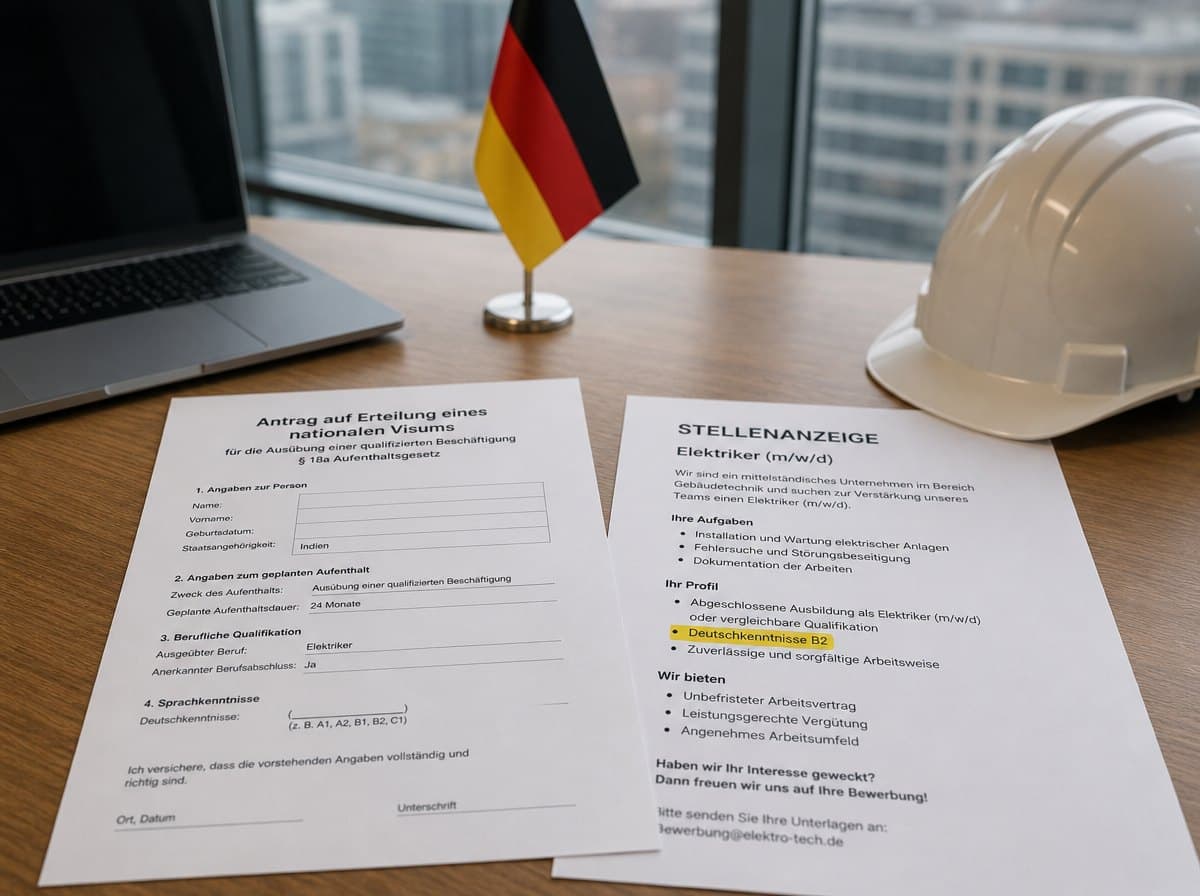
Ask an immigration lawyer how much German you legally need for Germany's skilled worker visa, and you will get an answer that surprises most people. Basically none. Ask someone who actually landed a job and moved there, and you will get a completely different number.
Both answers are true. That gap between them is where most applicants get stuck, and it is worth mapping out properly before you spend a year studying for a level nobody in a hiring office ever asked you for, or worse, arriving with too little and discovering the real bar after your flight is booked.
What the paperwork actually asks for
Germany runs three main routes into skilled work right now, and each one treats German differently.
The standard skilled worker visa under Section 18a, for people with a recognized vocational qualification, has no formal language requirement at the point of application. You can get the visa stamped without a single German word to your name. Section 18b, for university graduates, works the same way for the visa itself.
The Chancenkarte, Germany's points based job search visa, splits into two paths. If your foreign qualification is already fully recognized in Germany, you need zero language points at all. If it is not yet recognized, you go through the points system, and there you need at minimum A1 German or B2 English, whichever you can prove. That six point threshold is its own separate calculation, one we've broken down before.
The Anerkennungspartnerschaft, the newer route that lets you start working while your qualification recognition is still being processed, is the one exception. That path was built specifically around A2 German, and the employer has to commit to supporting you through both the language and the recognition process over three years.
So on paper: two of three main routes ask for nothing, and the third asks for a fairly modest A2.
Why "no language required" solves almost nothing
Here is the part the visa paperwork does not mention. A residence permit gets you into the country. It does not get you hired, and it definitely does not get you promoted.
Job postings in Germany, even for roles marketed internationally, routinely list German requirements that have nothing to do with what the visa demands. A logistics company hiring warehouse staff will often want B1 for safety briefings and shift handovers. An IT company that swears its working language is English will still expect B1 or B2 once you need to sit in on a budget meeting, read an internal memo, or deal with the Betriebsrat. Regulated professions go further still. Nurses and doctors need B2 recognized well before they touch a patient, language certificate and all, regardless of what their entry visa asked for.
This is the same pattern we've seen play out with the Ausbildung visa, where the legal minimum is B1 but employers, especially in healthcare, quietly expect B2 before they sign anything. The visa office and the hiring manager are simply not using the same rulebook.
There is also a slower cost to arriving at the legal minimum and stopping there. Colleagues switch to German the moment a meeting turns informal. Apartment hunting, doctor's appointments, and dealing with your Finanzamt all assume a level well past A1 or A2. People who land the job on English alone often spend their first year isolated from half of what is happening around them, and that isolation is a well documented driver of early return migration among skilled workers.
What level actually opens doors
If you are trying to plan backward from reality instead of the bare legal text, here is roughly where the real bar sits by situation:
- Manual and skilled trade roles (technicians, electricians, warehouse and logistics): A2 to B1, mostly for safety instructions and daily coordination with a team that may not speak English at all.
- Office and knowledge work in companies with an English working language: B1 comfortably, B2 if you want to be considered for anything beyond your specific technical lane.
- Regulated healthcare and education roles: B2 is close to a hard floor, and C1 is increasingly common for nursing and medical recognition.
- Anerkennungspartnerschaft applicants: A2 to enter, but budget for B1 within the first year since your recognition timeline runs alongside your actual job performance review.
- Chancenkarte points route applicants: A1 is the legal floor, but treat it as a starting line. You are searching for a job in Germany, competing against candidates who already speak B1 or better.
None of this means the legal minimum is meaningless. It tells you the earliest point you are allowed to move. It was never designed to tell you when you will actually feel competent, get taken seriously in a meeting, or stop needing a colleague to translate your mail.
The honest plan
If you are eligible for a route with no language requirement, use that as your green light to start the visa process, not as a reason to stop studying. Build toward B1 while your paperwork is moving, not after you land, because your job search, your first year of integration, and in most cases your path to permanent residency all run faster with it in hand.
Germanly's structured course paths are built around exactly this gap, taking you from the level the visa needs to the level the job and the life actually need, without guessing at which grammar rule matters this month.
The visa office will let you in with almost nothing. Everyone else you meet after that will not.
Start your own German story
A1 to B2 — vocabulary, grammar, real audio and AI feedback. First three lessons free.