Your Goethe B2 Won't Get You Into a German University. TestDaF Will
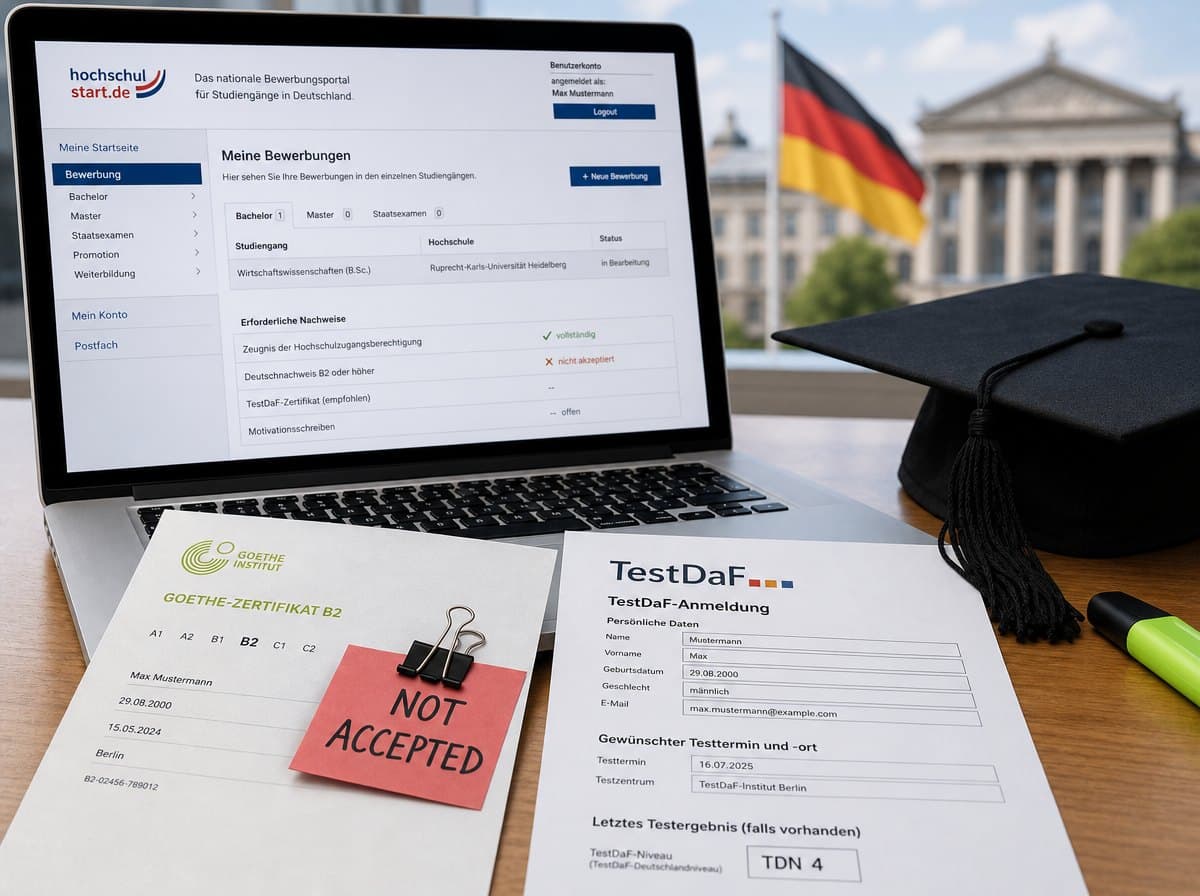
A student writes to us with a Goethe B2 certificate in hand, proud of it, and rightly so. They assume the hard part is over. Then the university portal asks for a TestDaF score or a DSH result, and the certificate they spent four months earning does not even appear as an option on the dropdown menu.
This happens constantly, and it is not because anyone lied to these applicants. Visa checklists, Ausbildung guides, and Opportunity Card scoring all treat Goethe and telc as interchangeable proof of general German ability, which they are. University admission for a German taught degree runs on a separate track entirely, with its own exam, its own scoring system, and its own registration calendar that most people discover far too late to matter.
What TestDaF actually measures
TestDaF was built for one purpose: proving you can survive academic German, not conversational German. The reading section pulls from real academic texts. The listening section includes recordings of actual university lectures, not tourist dialogue. The writing section asks you to interpret a graph or chart and build an argument around it, the exact task you would face in a seminar paper. The speaking section skips the human examiner entirely. You talk into a microphone and respond to prompts on a timer, which feels strange the first time and is worth practicing before exam day rather than on it.
Goethe and telc B2 test whether you can function in daily German life: ordering at a bakery, understanding a doctor, following a news segment. TestDaF tests whether you can sit through a two hour lecture on macroeconomics and take usable notes. Both are legitimate measures of German. They are just measuring different things, and only one of them is what most German universities actually ask for.
The score works differently too
Goethe and telc give you a pass or fail result tied to a CEFR level. TestDaF gives you a number for each of the four sections, called a TDN, on a scale that runs from 3 to 5. Most programs want at least TDN 4 across all four sections, sometimes written as "4 x TDN 4" or "TestDaF 16." A few competitive programs, particularly in law and some social sciences, ask for TDN 5 in at least one section. Some universities will accept a mixed result, say three sections at TDN 4 and one at TDN 3, but that is a case by case exception you need to request directly, not something you should plan around from the start.
For context, TDN 4 sits roughly at the B2 to C1 boundary. So the level itself is not wildly different from what a strong B2 or C1 telc certificate represents. The difference is entirely in what the exam is testing you on and whether your target program will even glance at a general proficiency certificate instead.
Where the timing actually bites
Here is the part that catches people off guard even when they know all of the above. TestDaF is not a walk in and book it next week exam. The digital sitting on August 25 this year had its registration window open back in January and close on August 14. If you are only now realizing your program wants TestDaF instead of Goethe C1, that date is already gone, and the next digital sitting lands in mid November, with a paper based option in mid October for anyone who prefers pen and answer sheet over typing and a headset.
That gap between "I found out I need this" and "the next available seat" is often two to three months, sometimes longer once you account for travel to a test center and result processing time afterward, which runs about four weeks. If your winter semester application is due in a matter of weeks and you are still holding a Goethe B2 certificate, you are not choosing between two equally valid options anymore. You are working against a calendar that does not care how prepared you are.
What this means if you are applying to a German university
A few things worth doing now rather than closer to your deadline:
- Check your target program's language requirement directly on the university or department page, not on a general guide. "German taught program" can mean TestDaF, DSH, or telc C1 Hochschule depending on the institution, and some accept more than one.
- If TestDaF is required, register for the next available sitting as soon as you know your target semester, even if your German is not exam ready yet. You can always prepare into a booked date. Once a registration window closes, there is no way to reopen it.
- Do not assume your existing Goethe or telc B2 certificate covers you here. It is genuinely useful groundwork for TestDaF prep, but it is not a substitute credential for admission purposes.
- Build your study plan backward from the exam date, the same way you would for a visa appointment. TestDaF rewards academic reading speed and structured argument writing specifically, skills that general conversation practice does not automatically build.
This is the exact gap that trips up strong German speakers who assumed fluency alone would carry them through admission. It will not, not because their German is weak, but because nobody tested them on the specific academic register the exam is looking for. Germanly's structured practice paths build toward the certificate a learner actually needs for their goal, university admission included, rather than assuming every learner is aiming at the same generic B2.
Check the requirement before you book the exam, and check the exam before you assume your existing certificate already covers it. The German universities are not being difficult on purpose. They are just testing for a different skill than the one your visa checklist cared about.
Start your own German story
A1 to B2 — vocabulary, grammar, real audio and AI feedback. First three lessons free.